

 CALL NOW
Tampa T-Bone Accident Lawyer
No Fees Unless We Win
If you were T-boned at a Tampa intersection, you already know how violent a side-impact crash can be. Federal data show that side impacts account for roughly 22 percent of passenger vehicle occupant deaths in the United States, and the doors and pillars beside you offer far less crush space than the front of a vehicle.
At Jack Bernstein Injury Attorneys, our Tampa T-bone accident lawyers fight for serious-injury victims across Tampa Bay. We handle every T-bone collision, broadside accident, and intersection crash on a contingency fee basis, so you pay nothing unless we recover compensation for you.
Contact us today for a free case evaluation.
If you need an injury attorney in Tampa, call Jack Bernstein, Injury Attorneys for results you can trust.
What is a T-bone accident?
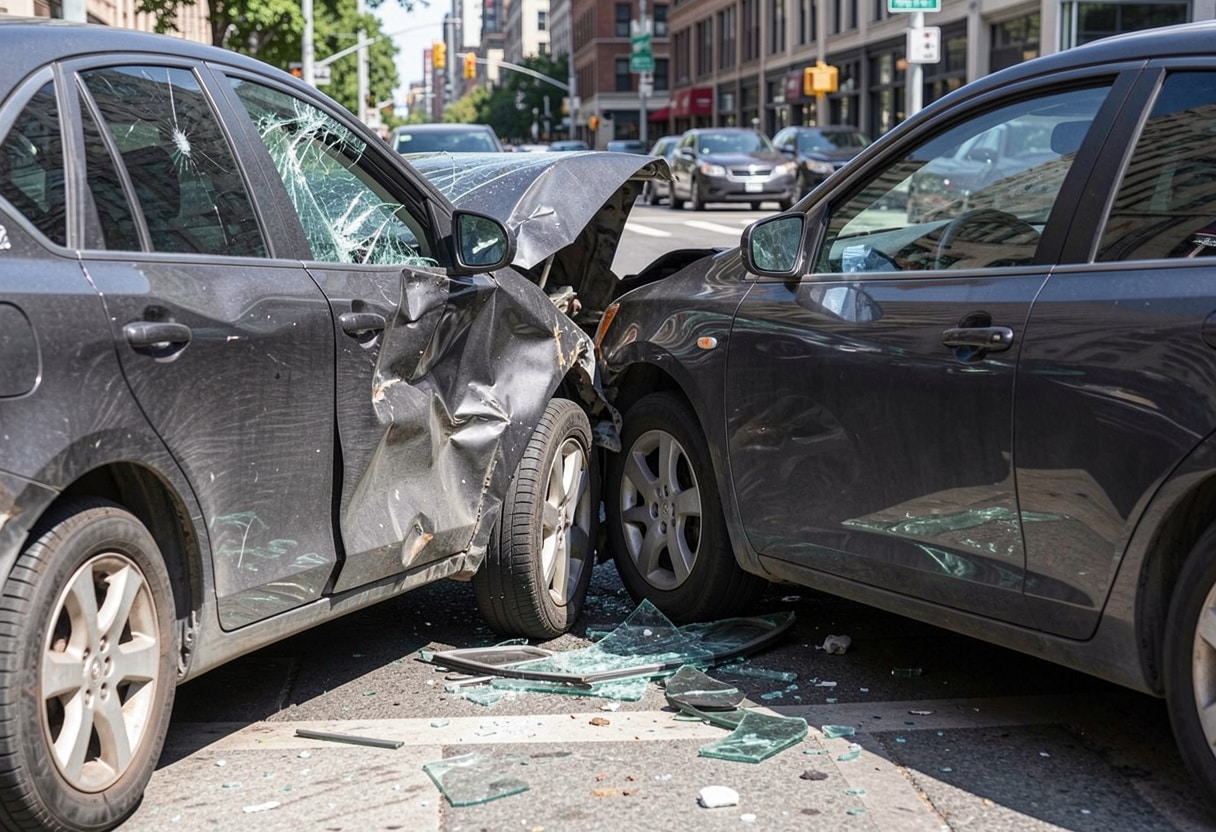
A T-bone accident, also called a right-angle or broadside collision (FHWA Intersection Safety Manual), happens when the front of one vehicle strikes the side of another at an intersection. The two vehicles form a rough “T” shape at the point of impact.
The Federal Highway Administration treats this as the most severe crash type at unsignalized intersections. Side-impact collisions are common across Tampa Bay, where one driver fails to stop or yield the right of way. Unlike rear-end car accidents, T-bone crashes send force directly into the passenger compartment on the struck side, where there is minimal structural protection between the occupant and the incoming vehicle.
T-bone accidents occur most often at:
- Signalized intersections where a driver runs a red light
- Stop-sign-controlled intersections in residential or commercial areas
- Unsignalized crossroads and highway on-ramps
- Parking lot exits and driveways meeting main roads
Common causes of T-bone accidents in Tampa
Tampa Bay’s grid of busy intersections, high-speed arterials, and tourist traffic produces thousands of broadside collisions every year. Understanding why these crashes happen helps build a strong T-bone accident claim. Below are the most frequent causes our car accident lawyers see in Tampa.
Running red lights and stop signs
Drivers who blow through red lights or stop signs collide with vehicles that have the right of way. The IIHS reports that 1,086 people were killed and more than 135,000 injured in red-light running crashes in 2023, and front-into-side collisions are the crash type most closely tied to running a red signal. Tampa intersections along Dale Mabry, Hillsborough Avenue, and Fowler Avenue are frequent hot spots.
Failing to yield the right of way
When a driver runs a stop sign or turns left into oncoming traffic at an intersection, the result is usually a perpendicular T-bone impact. The FHWA explains that more than 80 percent of rural intersection fatalities occur at unsignalized intersections, and failure-to-yield violations are the primary trigger. In Tampa, unprotected left turns at busy intersections cause a high volume of these crashes.
Distracted driving at intersections
Drivers checking phones, navigation screens, or in-car entertainment miss red lights and stop signs entirely. NHTSA data show that 3,208 people were killed in distraction-affected crashes nationwide in 2024. A single five-second glance at a phone at 55 mph carries a vehicle the length of a football field, which is more than enough distance to blow through a red light.
Impaired driving due to alcohol or drugs
Alcohol and drugs slow reaction times and impair judgment at the worst possible moment. NHTSA reports that 11,904 people died in alcohol-impaired-driving crashes in 2024, roughly 30 percent of all traffic deaths. Impaired drivers are far likelier to misjudge red lights or stop signs and broadside another vehicle. If the at-fault driver was under the influence, you may also have a DUI accident claim.
Serious injuries from T-bone accidents
The side of a vehicle has the least structural protection of any panel. There is no engine block, no crumple zone, just a thin door and a window between you and the incoming car. That is why T-bone accident victims suffer some of the most catastrophic injuries we see in personal injury cases. Common severe injuries include:
|
Injury category |
Examples |
Long-term impact |
|
Head and brain |
Traumatic brain injuries, concussions, skull fractures |
Cognitive deficits, personality changes, permanent disability |
|
Spinal cord |
Herniated discs, spinal cord damage, paralysis |
Partial or full paralysis, lifelong medical care |
|
Broken bones |
Fractured ribs, pelvis, shoulder, hip |
Surgical repair, months of rehabilitation |
|
Internal organs |
Internal bleeding, organ laceration, punctured lung |
Emergency surgery, risk of delayed complications |
|
Neck and back |
Whiplash, herniated discs, chronic pain |
Ongoing physical therapy, reduced mobility |
Head, brain, and spinal injuries
Side-impact crashes routinely produce traumatic brain injuries and spinal cord damage because the door and window line offer little crush space between the impact and the occupant’s head and torso. The CDC reports more than 67,852 TBI-related deaths in 2024, and the NSCISC documents about 18,421 new traumatic spinal cord injuries each year, with motor vehicle crashes the leading cause.
Broken bones and internal injuries
Because side impacts cause about 22 percent of passenger vehicle occupant deaths nationwide, the lateral forces in a T-bone crash often produce broken ribs, pelvic fractures, shoulder injuries, and internal bleeding from organ trauma. Victims frequently require emergency surgery and extended hospital stays. Internal injuries like a punctured lung or ruptured spleen may not present symptoms for hours after the crash.
Back, neck, and chronic pain issues
Side-impact crashes routinely produce whiplash, herniated discs, and chronic back and neck pain that may need months of physical therapy. The IIHS notes that side-impact crashes account for about a quarter of U.S. passenger vehicle occupant deaths and that occupants commonly present with neck sprains lasting three months or more. These injuries prevent accident victims from working and carry substantial medical expenses over time.
Wrongful death and fatal side-impact crashes
When a side-impact crash takes a life, surviving family members may bring a wrongful death claim against the driver who caused it. NHTSA records estimate 39,254 people died in U.S. traffic crashes in 2024, with intersection collisions accounting for a substantial share. Florida law allows spouses, children and parents to recover funeral costs, lost income, loss of companionship, and mental anguish.
What to do after a T-bone accident in Tampa
The steps you take in the first hours and days after a T-bone crash directly affect your ability to recover compensation. T-bone accident victims should follow these steps:
Seek medical attention and get treated
Get medical attention right away, even if you feel fine. Some serious injuries, like internal bleeding or traumatic brain injuries, do not produce obvious symptoms immediately. Florida’s no-fault PIP statute requires treatment within 14 days of the crash (Fla. Stat. § 627.736), or you can lose access to your $10,000 in personal injury protection benefits entirely. Medical records also document what the insurance company will later try to dispute.
Preserve evidence and document the scene
While still at the accident scene, gather as much evidence as possible:
- Photograph vehicle damage, skid marks, traffic signals, and road conditions
- Get contact information from witnesses
- Note any traffic cameras that may have recorded the crash
- Write down the other driver’s license plate, insurance details, and vehicle description
The FHWA reports that the most common violations at intersections are speeding, failure-to-yield, aggressive driving, and impaired driving. Proving any of those at trial depends on evidence preserved in the first hours after the crash.
File a police report and notify your insurance
Florida law requires a police report for any crash involving injury, death, or significant property damage. Your insurer expects prompt notice. Every Florida driver must carry at least $10,000 in PIP and $10,000 in property damage liability coverage. The police report is the first document every adjuster pulls when evaluating your insurance claim.
Contact a T-bone accident lawyer in Tampa
Call a T-bone accident lawyer as soon as possible. Evidence degrades fast: traffic camera footage is overwritten, witnesses forget details, and the insurance company starts building its defense from day one. A legal team can send preservation letters, request police reports, and begin investigating your T-bone accident claim while the evidence is fresh. Florida’s two-year statute of limitations means delays can permanently bar your right to recover compensation.
Florida law and your T-bone accident claim
Florida’s legal framework for auto accident claims changed substantially in 2023 with the passage of HB 837. If you are pursuing a T-bone accident claim, you need to understand these four rules.
The serious injury threshold and PIP in Florida
Florida is a no-fault state. Your own PIP coverage pays 80 percent of reasonable medical expenses up to $10,000 under Fla. Stat. § 627.736. To step outside no-fault and pursue pain-and-suffering damages, you must meet the serious injury threshold defined in Fla. Stat. § 627.737(2) (view statute). The four qualifying categories are:
- Significant and permanent loss of an important bodily function
- Permanent injury within a reasonable degree of medical probability
- Significant and permanent scarring or disfigurement
- Death
Most T-bone accident victims with spinal cord injuries, traumatic brain injuries, or broken bones will cross this threshold.
Florida’s comparative negligence rule
Florida is now a modified comparative negligence state. Under Fla. Stat. § 768.81(6), as amended by HB 837 in 2023, an injured driver who is more than 50 percent at fault for the crash recovers nothing. If your share of fault is 50 percent or less, your damages are reduced by that percentage but you still recover. This replaced the older “pure comparative” system where any plaintiff could recover regardless of fault percentage.
Two-year statute of limitations for T-bone claims
Tampa T-bone victims generally have only two years from the crash to file a personal injury lawsuit. HB 837 cut Florida’s negligence statute of limitations in half effective March 24, 2023, and the new two-year deadline is now codified in Fla. Stat. § 95.11. Wrongful death actions also carry a two-year deadline measured from the date of death. Missing this window permanently bars your claim.
How insurance and coverage work
Florida requires drivers to carry at least $10,000 in PIP and $10,000 in property damage liability, but bodily injury liability is not mandatory. That means the at-fault driver may carry no liability coverage at all. Your own uninsured motorist coverage under Fla. Stat. § 627.727 fills this gap and can be the difference between a full recovery and nothing.
What compensation can you recover after a T-bone accident?
T-bone accident victims in Florida can pursue three categories of damages once they meet the serious injury threshold. The U.S. Department of Transportation puts the annual economic cost of motor vehicle crashes at roughly $340 billion and individual catastrophic cases routinely run into six and seven figures.
Economic damages (medical bills and lost income)
Economic damages cover tangible financial losses you can document with receipts, records, and pay stubs:
- Emergency room visits, surgeries, and hospital stays
- Physical therapy, rehabilitation, and ongoing medical treatment
- Prescription medication and assistive devices
- Lost wages during recovery
- Lost earning capacity if injuries prevent you from returning to your former job
- Property damage and vehicle replacement costs
For severe T-bone crash victims with spinal cord injuries or traumatic brain injuries, medical expenses alone can exceed $1 million in the first year (NSCISC 2025).
Non-economic damages and pain and suffering
Non-economic damages cover the physical pain, emotional distress, and reduced quality of life caused by the crash. Under Fla. Stat. § 627.737(2) (view statute), Florida only allows recovery of these damages when the victim has crossed the serious injury threshold. Recoverable non-economic losses include:
- Physical pain and chronic discomfort
- Emotional distress, anxiety, and PTSD
- Loss of enjoyment of life and recreational activities
- Impact on relationships and family life
- Permanent scarring or disfigurement
These damages are not capped in Florida for standard negligence claims.
Wrongful death and loss of a loved one
If a side-impact crash takes a life, Fla. Stat. § 768.21 (view statute) allows surviving spouses, children, and parents to recover for:
- Funeral and burial expenses
- Lost support, services, and income the deceased would have provided
- Loss of companionship, guidance, and protection
- Mental pain and suffering of survivors
Our wrongful death attorneys work with economists to calculate the full lifetime value of these losses.
How a T-bone accident lawyer in Tampa can help you
Handling a T-bone accident claim on your own puts you at a disadvantage against trained insurance adjusters and defense teams. Here is what our legal team does for every client.
Investigating the intersection crash and proving negligence
Our team works with accident reconstruction experts who pull Florida’s official crash data systems for signal timing, vehicle paths, and police reports (FDOT Crash Data Systems). We pair that data with traffic camera footage, witness statements, and physical evidence from the accident scene to rebuild what happened in the moments before impact. Proving the other driver violated the right of way, ran a red light, or was distracted is the legal burden we carry for you.
Dealing with insurance companies and adjusters
Insurance companies do not volunteer policy limits. Under Fla. Stat. § 627.4137, an insurer must produce a sworn statement of coverage within 30 days of a written request from a claimant or attorney. We use that lever to find every dollar of coverage available. Our lawyers handle all communication with adjusters so you do not accept a lowball settlement before you know the full extent of your injuries.
Building a case for long-term recovery
Severe T-bone victims often need decades of follow-up care. The NSCISC reports that first-year costs for high-tetraplegia spinal cord injuries can exceed $1 million. We coordinate life-care planners, vocational economists, and medical experts to project the full lifetime cost of catastrophic injuries before we ever talk settlement. That documentation prevents the insurance company from undervaluing your claim.
Representing you in court if needed
Most T-bone accident claims settle before trial, but insurance companies pay more when they know you will go to court. Our firm prepares every case as if it will go to a jury. We have secured results in verdicts and settlements for clients across Tampa Bay, and that trial-ready reputation gives our negotiations weight. You work on a contingency fee basis, so there are no fees unless we win.
What compensation can you recover?
Florida law divides recoverable damages into economic and non-economic categories. In severe cases, wrongful death damages are also available.
Economic damages (medical bills and lost income)
Economic damages cover every tangible financial loss caused by the Instacart accident:
- Emergency room visits, hospital stays, and surgeries
- Physical therapy, rehabilitation, and ongoing medical care
- Prescription medications and medical equipment
- Lost wages during recovery
- Lost earning capacity if you cannot return to your previous job
- Vehicle repair or replacement costs
The BLS reports that the median annual wage for light truck/delivery drivers was $44,140 in May 2024. Lost-wage calculations for injured victims often use similar benchmarks to project future losses.
Non-economic damages and pain and suffering
Non-economic damages compensate for losses that don’t carry a specific dollar amount:
- Physical pain and suffering
- Emotional distress and mental anguish
- Loss of enjoyment of life
- Permanent disability or disfigurement
- Impact on family relationships and daily activities
Florida’s Standard Jury Instructions guide jurors on how to evaluate these subjective losses, and an experienced attorney knows how to present them effectively.
Wrongful death and loss of a loved one
If a family member died in an Instacart-related crash, Florida’s Wrongful Death Act allows surviving family members to recover funeral and burial expenses, loss of the deceased’s income and support, loss of parental companionship (for minor children), and mental pain and suffering of survivors. The two-year statute of limitations under § 95.11(5)(d) applies. Contact a wrongful death lawyer immediately if you’ve lost someone.
How an Instacart accident lawyer in Tampa can help you
Gig-economy accident claims are more complex than standard car crash cases. Multiple insurance policies, contractor-vs-employee disputes, and disappearing digital evidence all require a legal team that knows where to look and how to fight.
Investigating the crash and finding all liable parties
Our legal team gathers police reports, app data, trip records, driver background-check history, and any available surveillance or dash-cam footage. We assess whether claims for negligent hiring or defective system design apply against Instacart directly, and we identify every party whose negligence contributed to your injuries.
Dealing with insurance companies and negotiating
Insurance adjusters work for the company, not for you. They use tactics like lowball offers, recorded statements, and delay to reduce your payout. Our firm handles all communication with insurance companies and fights for the full value of your claim. According to the Insurance Information Institute, the average auto liability claim payout continues to rise, and victims who retain attorneys typically recover more than those who settle on their own.
Building a case for fair compensation
We work with medical experts to document the full extent of your injuries, economists to calculate lifetime lost earning capacity, and accident-reconstruction specialists to establish exactly how the crash happened. This evidence-driven approach produces stronger results whether your case settles or goes to trial.
Representing you in court if needed
Most T-bone accident claims settle before trial, but insurance companies pay more when they know you will go to court. Our firm prepares every case as if it will go to a jury. We have secured results in verdicts and settlements for clients across Tampa Bay, and that trial-ready reputation gives our negotiations weight. You work on a contingency fee basis, so there are no fees unless we win.
About Jack G. Bernstein Esq.
Personal Injury Lawyer

For more than 40 years, personal injury lawyer Jack G. Bernstein — a member of the Florida State Bar Association, the Hillsborough Bar Association, and the Clearwater Bar Association — has protected the rights of individuals injured by a negligent party.
Mr. Bernstein has the expertise to handle various injury cases, including, but not limited to, car accidents, medical malpractice cases, cruise ship accidents, accidental drownings, wrongful death lawsuits, along with most injury and catastrophic occurrences, and legal malpractice issues.
With a staff of approximately 40 people, including six lawyers and 34 support personnel, Jack Bernstein, Injury Attorneys, handles every type of personal injury and accident case throughout Tampa, Sarasota, St. Petersburg, and Clearwater, FL. Our office has the legal resources to get the justice you deserve and the maximum recovery for your losses. Schedule your free consultation today; we are always here to help.
T-bone accident FAQs in Tampa
Testimonials
Read what our clients have to say.