

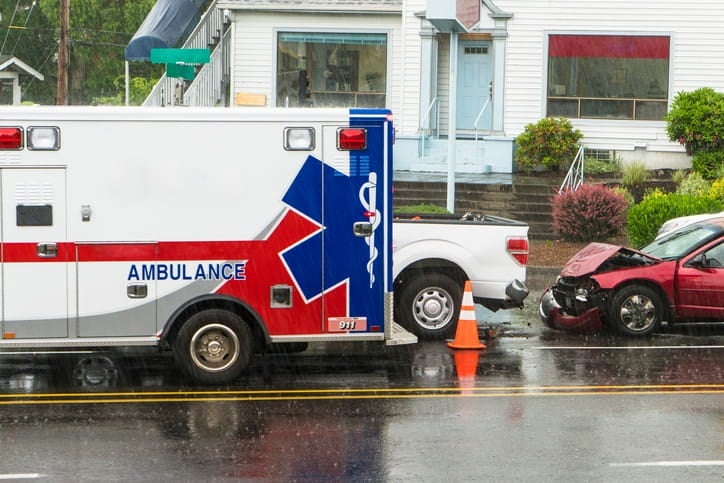
Do you know what to do after a car accident?
According to the National Highway Traffic Safety Administration (NHTSA), one person is injured in a motor vehicle crash every 10 seconds, and one fatality occurs every 13 minutes. Additionally, 38,824 people were killed in motor vehicle traffic crashes in 2020. Thus, accidents are a serious matter.
Understandably, immediately after a crash, you may be experiencing shock, confusion, and be overwhelmed, which, although they are normal reactions to trauma, can prevent you from making informed decisions at the accident scene.
Jack Bernstein, Injury Attorneys, is dedicated to helping injured victims obtain accurate and comprehensive information. We are providing this guide to help you know the right steps to take after a car accident to protect your health and legal rights.
Were you injured in a car accident? Contact Jack Bernstein, Injury Attorneys, now.
Immediate Safety Steps at the Accident Scene (First 5 Minutes)
With the psychological shock and disorientation you are likely to be experiencing after a car accident, whether minor or serious, you may make mistakes. Thus, take a few deep breaths to calm down, then follow these steps:
Step 1 – Assess Injuries and Call for Help
Check yourself for visible injuries like cuts and swelling, and then pat yourself down to check if you feel pain in any body part. Additionally, gently try to move your limbs and take note of feelings of dizziness or nausea. After assessing yourself, check your passengers and other parties involved.
If anyone is injured, call 911 immediately to get medical help and police response. Note that some symptoms of serious injuries may not be immediately obvious at the accident scene. Immediate medical care is crucial in identifying such symptoms.
Step 2 – Secure the Scene and Prevent Further Accidents
To prevent further accidents, turn on the hazard lights and set up road flares or reflective triangles, if available, to alert other drivers of the accident. Then, move your vehicle to a safe place, if you can safely do so. Take photos of the accident scene and the vehicles before moving.
If anyone has sustained a serious injury that could worsen if moved, or your car is so unsafe to operate that moving could lead to further damage, stay put.
Step 3 – Contact Law Enforcement
In Florida, you are required to report a motor vehicle accident to the police when it involves an injury, death, or at least $500 estimated property damage. The property damage threshold in some states is $1,000.
Police are required to respond to a scene when these requirements are met. Otherwise, a driver can file a “Driver Report of Traffic Crash (Self Report)” with the Florida Highway Safety and Motor Vehicles (FLHSMV) within 10 days of the incident.
The police may fail to respond to a mandatory incident because of limited available personnel or extreme weather/traffic conditions. In such a situation, a driver is also required to self-report.
When you call law enforcement, provide the 911 dispatcher with your exact location, confirm if anyone is injured/trapped/unconscious, give a description of the involved vehicles, state the nature of the incident, and provide your information. The police should arrive within a reasonable time to file an accident report.
Critical Information Exchange Protocol
While waiting for the police, exchange information with the other driver. This is required by law in all states.
You may encounter a few difficulties when interacting with the other party, such as an uncooperative driver, language barriers, or an intoxicated party. If this happens, remain calm, politely ask for the necessary details, and use translation apps and non-verbal communication when necessary. Additionally, consider using smartphone apps and tools to organize information.
Here are the details to collect:
Required Driver and Vehicle Information
You are legally required to obtain the other driver’s name, address, license number of the vehicle, and insurance information (company name and policy number), and provide them with your details. Politely ask them to provide you with their driver’s license and insurance card. Use your phone to photograph them.
Don’t forget to record the vehicle’s information (make, model, year, vehicle identification number, and license plate).
Witness Information Collection
Independent witnesses are considered to provide unbiased and credible accounts that can help determine fault in car accident claims, especially disputed ones. Thus, after you exchange information with the other driver, approach witnesses before they leave the scene. This can be a local business owner, other passengers/drivers, cyclists, or pedestrians.
Inform them you were involved in the accident they just witnessed and that you are gathering information and would appreciate it if they provide you with their information. You can also request them to provide recorded brief statements to preserve fresh, detailed accounts of the incident. Use your smartphone voice recordings for witness statements.
Documentation and Evidence: Building Your Case from Hour One
Are you well-informed about how to collect evidence after a car accident?
Memory usually fades and evidence disappears. Therefore, you should thoroughly document the accident scene to preserve evidence. Of course, it can be challenging to move around gathering evidence when you are shaken or injured, but good documentation of injuries and property damages can mean thousands of dollars in additional compensation.
Photography and Video Documentation Checklist
Photos and videos serve as solid evidence of an accident. Consider taking more than 20 shots, documenting the vehicle damage using multiple angles, both close-up and wide shots. You should also capture the street-level view, showing traffic signals, signs, and road conditions.
Take photos and videos of the interior damage, deployed airbags, and property damage to your other belongings. You also need photo evidence of your injuries and, with consent, the injuries of other involved parties.
Written Documentation and Digital Evidence
Written documentation of the incident is important in evidence preservation. Before your memory fades, note down the date, time, and location of the accident, how it happened, and a description of the road and weather conditions. Use smartphone voice memos for quick accident documentation.
You also need digital evidence to strengthen your case. Therefore, preserve your dash-cam footage, data from vehicle navigation systems, and other electronic evidence.
What Not To Say or Do
As it’s important to know what to do after a car accident with injuries, you should also know what not to do. For starters, never admit fault, even if you think you caused the accident. Additionally, avoid apologizing, as this can be construed as an admission of guilt.
When exchanging information, avoid discussions about the cause of the accident or who to blame. The evidence you gather will establish legal liability.
Your Insurance Coverage and Claims Process
The mandatory coverages for registered vehicles in Florida are a minimum of $10,000 in personal injury protection (PIP) and a minimum of $10,000 in property damage liability (PDL). PIP covers your own medical expenses and lost wages, and PDL covers damage to other people’s property.
You can file an insurance claim with your insurance company and the other driver’s, which means you may deal with multiple insurance companies in your claims process. This can be complicated, seeing that you have to coordinate between different insurers.
Filing Your Insurance Claim
You are required to notify your insurance company about the accident as soon as possible, which is usually within 24 to 72 hours. Your specific policy may outline the timeframe to observe.
The information to give your insurer includes details of the accident and injuries, information about the other driver and their vehicle, witness information, and a description of the vehicle damage.
To file a claim, you will formally request your insurer to compensate you from your insurance coverage.
If you need coverage for damages beyond your PIP coverage, you can initiate a claims process with the other driver’s insurer. If they don’t have insurance, you can recover damages from your uninsured/underinsured motorist (UM/UIM) coverage, or you can file a lawsuit against them.
How To Deal With Insurance Adjusters
How insurance companies inspect car accident claims is aimed at finding evidence that helps them better understand the accident and the validity and value of the damages. However, claims adjusters also look for anything that could reduce the value of the claim. Thus, it helps to know how to deal with insurance adjusters to protect yourself.
First of all, understand your rights. Furthermore, pay attention to red flags that indicate bad faith insurance practices, such as unjustified claim denial, unreasonable delays in processing, and a low settlement offer.
Consider involving an attorney from the time interactions with insurance companies begin to receive guidance from the start.
Medical Care: Protecting Your Health and Your Claim
Medical treatment after a car accident helps prove the crash caused your injuries. Consistent medical care is also important, as it protects your well-being. In addition, it establishes the severity of your injuries, which will be used when determining your claim value.
Immediate Medical Evaluation
Even if you don’t have visible injuries after a crash, you should get immediate medical attention. You may have sustained serious injuries whose symptoms will not be immediately obvious, such as whiplash, concussion, and soft tissue injuries, because the adrenaline your body releases is masking pain.
Go to the emergency room if you have a serious visible injury like a fracture, an urgent care center if you have a non-life-threatening injury like cuts, or to a primary care physician for a medical evaluation.
Insurance companies can use gaps in medical treatment to argue that your injuries were not caused by the accident.
Ongoing Treatment and Documentation
After the initial medical treatment, you should follow all medical provider recommendations throughout your ongoing care.
Also, keep detailed records of appointments, treatments, medications, and medical expenses, and a detailed injury journal recording your pain levels on a scale of 0 – 10. You can connect all treatments back to the accident using medical documentation.
State-Specific Legal Requirements Across America
States have different rules that affect car accident victims. Examples of these legal requirements are at-fault vs. no-fault states, mandatory reporting state requirements, and statute of limitations.
At-Fault vs. No-Fault State Differences
In an at-fault state, fault determination is an integral part of a car accident claim. The driver who is found liable will compensate the other driver, typically through their liability insurance.
In a no-fault state, such as Florida, Kansas, Pennsylvania, Michigan, and New York, a driver’s PIP coverage covers their initial medical expenses and lost wages, regardless of who is at fault.
No-fault states have unique requirements when it comes to the minimum PIP coverage to have and verbal (serious injuries) and monetary (medical expenses) thresholds for filing lawsuits.
Reporting Requirements and Deadlines
States have different reporting requirements. In most states, involved parties should report an accident to the police immediately if it involves an injury, fatality, or significant property damage.
Additionally, they may be required to file a report with the DMV within a particular timeframe, which is within 10 days of the incident in Florida, Pennsylvania (five days), and New York (10 days). Insurance companies also have notification timeframes that should be followed.
The statute of limitations for filing lawsuits varies by state. In Florida, it’s two years from the date of the accident, Pennsylvania (two years), New York (three years), Michigan (three years), and Kansas (two years).
Failing to observe legal deadlines can affect your rights to compensation. Ensure you are well-informed about your state law.
Special Considerations for Florida Accident Victims
Many Florida car accidents are reported in urban centers with high populations and tourist-heavy regions. Adverse weather conditions and the high number of elderly drivers has also been associated with the accidents reported.
This means any Florida driver can be at risk of an accident. Thus, it’s vital to understand Florida law regarding no-fault insurance and Florida PIP to fight for your rights.
Florida’s 14-Day PIP Rule
Florida has a 14-day rule, which requires anyone injured in a car accident to receive medical care from an eligible medical provider within 14 days after the crash to qualify for PIP benefits.
An eligible medical provider is a licensed physician, dentist, chiropractic physician, or an advanced practice registered nurse. The medical provider needs to determine that the injured person has an emergency medical condition (EMC) to receive PIP benefits.
The common misconceptions about Florida PIP you may hear are that it covers everything, prohibits lawsuits, and only covers car accidents. Our thorough Florida’s 14-day PIP rule guide explains everything, so injured victims have accurate information.
Florida’s Comparative Negligence and Serious Injury Thresholds
In Florida, if fault determination shows you are 51% or more at fault, you will not receive compensation. This is the state’s comparative negligence law.
Additionally, if you meet the serious injury threshold, as defined by the Florida Statute 627.737, you can step outside no-fault and sue for damages. Accidents that occur in high-risk areas, such as I-4, I-95, and tourist areas, are likely to result in serious injuries.
Florida’s personal injury statute of limitations was reduced from four years to two years in 2023. This has increased the need to act fast.
When To Hire a Car Accident Attorney
Legal representation is essential. A car accident attorney can help you know what to do if you’re injured in a car accident. Additionally, your personal injury attorney will help you avoid common mistakes after car accidents in Sarasota, FL.
Thus, if you were wondering when to hire an attorney after a crash, the answer is as soon as possible.
Warning Signs You Need Legal Help
You need an attorney if:
- You have sustained serious injuries that require extensive medical treatment.
- There is a disputed liability, or you were involved in a complex accident scenario.
- You have noticed bad faith practices from an insurance company.
- Multiple parties were involved in the accident.
- A commercial vehicle or government entity is involved in your case.
How Attorneys Maximize Your Compensation
Attorneys maximize compensation using their legal expertise. Firstly, their evidence investigation and preservation capabilities allow them to build a strong case. They also know and can weaken the tactics insurance companies use to reduce payout or deny liability.
Lawyers also have access to accident reconstruction experts and medical professionals. Therefore, they can easily learn more about how an accident happened and gain intel on a client’s injuries.
In addition, their knowledge of full compensation calculation, including future damages, allows them to fight for what clients deserve. And when settlements aren’t adequate, they have trial experience to fight in court.
Common Mistakes That Can Destroy Your Case

Some injured victims make claim mistakes that lead to a denial of their claim, financial hardship, and even legal trouble. Anyone can make legal errors because of the psychological factors involved in car accidents. However, you have to be extra cautious to recover case damages.
Social Media and Communication Pitfalls
Insurers usually conduct insurance surveillance on a claimant’s social media accounts for activities that contradict their injury claims, such as hiking, dancing, and sports. Further, they look for comments like “feeling better” or “having fun,” when responding to inquiries from loved ones.
You should avoid these social media mistakes. Also, have professional communication boundaries with insurance companies. Giving recorded statements or your opinions can affect the case damage.
Settlement and Medical Treatment Errors
Never accept the first settlement offer. A premature settlement is almost always a lowball offer. You should also avoid having medical treatment gaps. Seek medical treatment immediately after the accident and don’t stop treatment too early.
Another settlement mistake is signing documents without legal review. You may waive your right to file a lawsuit without knowing. Also, never settle without fully understanding the extent of your injuries.
About Jack G. Bernstein Esq.
Personal Injury Lawyer

For more than 40 years, personal injury lawyer Jack G. Bernstein — a member of the Florida State Bar Association, the Hillsborough Bar Association, and the Clearwater Bar Association — has protected the rights of individuals injured by a negligent party.
Mr. Bernstein has the expertise to handle various injury cases, including, but not limited to, car accidents, medical malpractice cases, cruise ship accidents, accidental drownings, wrongful death lawsuits, along with most injury and catastrophic occurrences, and legal malpractice issues.
With a staff of approximately 40 people, including six lawyers and 34 support personnel, Jack Bernstein, Injury Attorneys, handles every type of personal injury and accident case throughout Tampa, Sarasota, St. Petersburg, and Clearwater, FL. Our office has the legal resources to get the justice you deserve and the maximum recovery for your losses. Schedule your free consultation today; we are always here to help.
FAQs
Immediate Post-Accident Questions
Insurance and Legal Process Questions
Contact Jack Bernstein, Injury Attorneys, for Your Car Accident Case
Were you injured in a car accident? Contact Jack Bernstein, Injury Attorneys, now.
Our car accident lawyers in Tampa are passionate about helping injured victims fight for their rights, including those injured in bicycle accidents. Reach out to know what to do if you’re injured in a bicycle accident.
We offer free consultations with no upfront costs. Call us at 813-333-6666, or use the online form/live chat. We are available 24/7 to offer quick responses.
Due to the statute of limitations and evidence preservation, you should act fast to recover lost wages in your personal injury case and other damages.
Remember, no fees unless we win.
Free Case Evaluation
No Fees Unless We Win
No upfront fees, no risk, and no out of pocket cost to you or your family.
Entirely confidential – we respect your privacy, consultations are privileged.