

What Does a Double Solid Yellow Line Mean?
You might be an aspiring driver gearing up to take a permit or driving test soon or an experienced driver who might need a nice refresh of the road rules. Either way, knowing and understanding the yellow road signs and their meanings are essential for staying safe on the road.
While there are many rules and regulations for driving, understanding the pavement markings on one-way and two-way streets is necessary when sharing the road with other drivers. Whether you are an experienced or inexperienced driver, it never hurts to brush up on practical and safe driving laws and regulations. In doing so, you keep yourself and other drivers safe while on the road.
What do double yellow lines mean?

A double solid yellow line marks the center of a two-lane road where traffic travels in both directions. A double solid yellow line indicates that there is absolutely no passing or crossing the double solid yellow line at any time.
Shifting into another lane or attempting to pass another vehicle is not allowed when a double solid yellow line is present. Even if you are unaware of a no passing sign, it is never permitted to cross over a double solid yellow line.
Can you cross a double solid yellow line?
There are no instances where you are allowed to cross a double solid yellow centerline on a two-way street. Suppose a double solid yellow line is present at any time on a roadway. In that case, you cannot cross it under any circumstances.
Have you recently been involved in a personal injury or automotive accident?
When Are You Legally Allowed to Cross a Double Solid Yellow Line?
Double yellow line means traffic is moving in opposite directions on a two way street and crossing the double solid yellow line is generally prohibited. The general rule is simple. A solid double yellow line tells drivers to stay in their lane and avoid crossing into oncoming traffic.
However, in such cases as turning left into a driveway or onto a private road, many traffic laws allow a brief cross over the yellow centerline. This is not considered passing and does not turn the road into a passing lane. Drivers must still yield to other traffic, check blind spots, and complete the turn safely.
Penalties and Risks of Crossing Double Solid Yellow Lines
If you cross double solid yellow lines, it counts as a traffic violation that can lead to fines. It can also lead to points on your license or worse if an accident occurs. These lane markings exist to prevent head on collisions on a two lane road where visibility is limited.
In case you ignore yellow lines, it puts drivers at risk of striking other vehicles and cyclists near a bike lane. If a driver crosses a solid yellow line and causes a crash, it may be used as evidence of unsafe driving.
What does it mean when the road is marked with a solid yellow line?
A solid yellow line on a road marks the middle of a road that has two-way traffic going in either direction. When a route is marked with a solid yellow line instead of a double solid yellow line, it indicates that you are not permitted to cross.
Consider an instance where there is a single solid yellow line next to a single dotted yellow line. If your vehicle is on the side of the single solid yellow line, then you are not allowed to pass or cross over that single solid yellow line.
What does a solid white line mean?
Solid white lines separate lanes of traffic when traffic is moving in the same direction. A solid white line indicates that you must stay in the lane you are currently in and not cross over the line into a different lane of traffic. Additionally, solid white lines mark the shoulder of the road that you are traveling on, sometimes referred to as fog lines.
In some states, wide solid white lines direct traffic into particular lanes. Crossing a wide solid white lane line is permitted but highly discouraged.
What do broken white lines mean?
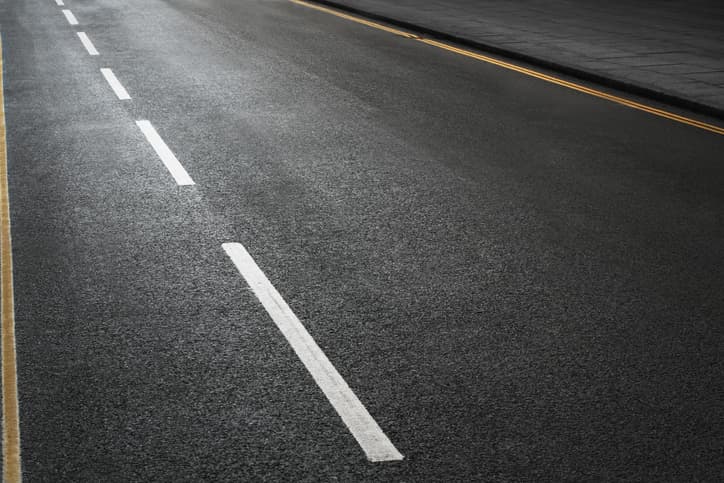
A broken or dotted white line marks the separation between car lanes traveling in the same direction on a road or street. When traveling in a lane with a broken or dotted white line, this indicates that you can cross over the line and change lanes. Always check your mirrors and blind spots before attempting to change lanes. Even after checking for oncoming traffic, stay vigilant when crossing a broken white line and shifting into a different traffic lane.
What does a broken yellow centerline mean?
A broken yellow line means that you are allowed to pass when it is safe to do so. The broken yellow lines mark the center of a two-lane highway or street where traffic is moving in both directions. When a broken yellow centerline is present, the line indicates that you are in a passing lane and can change lanes to pass traffic only if it is safe. When crossing over a broken yellow centerline to pass another vehicle, the maneuver must be completed safely and as quickly as possible.
Crossing over a dashed yellow line to pass another vehicle can be extremely dangerous. Be vigilant and careful when attempting to pass another vehicle and cross over a broken yellow centerline. Remember that a broken centerline in yellow paint indicates that there is a potential for oncoming traffic heading opposite your direction to be in the lane you are moving into.
Have you or a loved one become a victim of hazardous driving? You may qualify for financial compensation.
Hopefully, you now better understand pavement markings on two-way and one-way streets and how to better interact with what the road is telling you to do or not do. When you get behind the wheel, always practice safe and practical driving knowledge.
Frequently Asked Questions (FAQs)
About the Attorney

Jack G. Bernstein, ESQ.
Jack G. Bernstein is a veteran Florida personal injury attorney with over 40 years of experience practicing since 1983, successfully litigating 50,000+ cases spanning car accidents, truck accidents, slip-and-fall accidents, wrongful death and complex personal injury claims. A proud University of Miami School of Law graduate, he holds active membership in the Florida Bar Association and Clearwater Bar Association. Jack delivers relentless, client-first advocacy to maximize compensation and justice in every case.